
As financial distress represents a persistent global challenge to economic stability, the timely identification and evaluation of financially distressed companies is essential. In Belgium, this task lies with the Chambers for Companies in Difficulty(CCDs), a specialised division within the commercial courts. The CCDs play a pivotal role in detecting, monitoring, and addressing financially distressed companies through both preventive and regulatory measures.
The existing approach to identify companies at risk, which relies mainly on the manual assessment of so-called “red flags”, is both time-consuming and inconsistent. Therefore, our research team at Ghent University launched a pilot project in collaboration with the Commercial Court of Antwerp. The goal is to develop an Artificial intelligence (AI)-based decision support system that improves the efficiency, consistency, and objectivity of the CCDs decisions regarding which companies should be investigated.
Although this initiative originates within the Belgian context, the challenges addressed are far from unique. (Insolvency) courts across Europe face similar pressures: high case volumes, limited staff, financial resources, and the need for early intervention. There is currently a clear lack of research on predicting judicial decisions in insolvency law, and our work aims to address this gap in the literature.
Chambers for Companies in Difficulty
Within each Belgian commercial court, one or more CCDs operate as specialised units responsible for monitoring the financial situation of companies under their jurisdiction and assisting those showing signs of financial distress. In order to facilitate the detection of distressed companies, CCDs can rely on various indicators of financial distress, including outstanding tax or social security debts, asset seizures, failure to file annual accounts, and judgments terminating commercial leases. These indicators, commonly referred to as “red flags” are largely gathered within a centralised digital database known as KNICLI (short for KNIpperlichten/CLIgnotants representing the Dutch and French terms for “red flags”).
When these indicators suggest that a company is facing financial distress, the CCD can invite the company’s representatives to an informal consultation to explore potential recovery measures. This early engagement illustrates the CCD’s preventive function, which aims to encourage corrective action before a company’s difficulties become irreparable. In addition to this preventive role, the CCD also fulfils a regulatory function. Namely, when a financially distressed company is no longer viable, the CCD guides it towards appropriate legal proceedings, such as bankruptcy or dissolution.
Limitations of the current selection process
When a company incurs an outstanding tax or social security debt, a red flag is automatically triggered, signalling potential problems. Naturally, not every red flag triggered corresponds to genuine financial distress; there may be alternative explanations. Consequently, CCDs must decide which flagged companies warrant further investigation. This selection process poses significant challenges. Given the large number of alerts generated by the KNICLI database, it is impossible for CCDs to examine each case manually. Limited resources, time constraints, and the sheer volume of potentially distressed companies make efficient manual selection a central difficulty in the current process.
This problem is further exacerbated by the lack of uniform selection criteria. The factors used to select and prioritise cases differ between CCDs and may even fluctuate within the same CCD over time. For example, in one period a certain CCD might focus on companies that have failed to file their annual accounts, while in another, attention may shift toward companies with outstanding social security debt. Such an ad hoc approach leads to inconsistencies, reduces procedural transparency, and increases the likelihood that companies requiring urgent intervention are either overlooked or identified too late.
An AI-based decision support system as a solution?
To assist the CCDs in their selection process, we are currently developing an AI-based decision support system. The system uses historical CCD decisions combined with red-flag data and annual accounts data, the system aims to assist in the selection of companies by producing not only a list of potentially relevant cases but also a ranking of companies according to the estimated urgency of their financial situation. A future development phase will enable the system to classify cases into likely decision outcomes, such as further investigation, referral to bankruptcy proceedings, or a request for additional financial information. It is essential to emphasise the purely supportive nature of the system. Its recommendations will be strictly non-binding and are intended solely to assist judges in making faster and more consistent decisions. Judges will retain full discretion to accept, adjust, or disregard the system’s proposals at any time.
From pilot project to prototype: The Antwerp case study
The collaboration with the Commercial Court of Antwerp marks the project’s transition from conceptual design to empirical testing. Development began with a comprehensive data collection phase, documenting all companies flagged in the KNICLI database, those selected for further examination, and the resulting judicial decisions. Between March 2023 and February 2024, the Antwerp chamber registered 9,657 flagged entities. Of these, only 610 were examined in detail, generating 2,869 formal decisions, which include investigation rulings, case closures, and bankruptcy referrals, as several decisions may pertain to a single company.
Although this dataset is not yet large enough to train a fully operational model, it has enabled the construction of an exploratory prototype. This preliminary version focuses on predicting the probability for a company to be referred to bankruptcy or dissolution proceedings. By ranking companies according to risk, it offers a tangible illustration of how AI can help CCDs allocate their limited investigative capacity more strategically.
The Antwerp pilot demonstrates that AI can serve as a valuable instrument in the Belgian insolvency framework and as a model for other jurisdictions confronting comparable insolvency challenges, helping to improve the consistency and efficiency of decision-making and to enable more effective prioritisation.
Conclusion
Our project illustrates how artificial intelligence can reinforce, rather than replace, the decision-making process of judges. By integrating an AI-based decision support system into the operations of the CCDs, we aim to enhance the consistency, transparency, and efficiency of the CCDs’ process of selecting and prioritising companies for further investigation.


*This research blog was written by: Aruna Audenaert and Stijn Van Ruymbeke, PhD Candidates at Ghent University.
About BWILC and the PhD Workshop
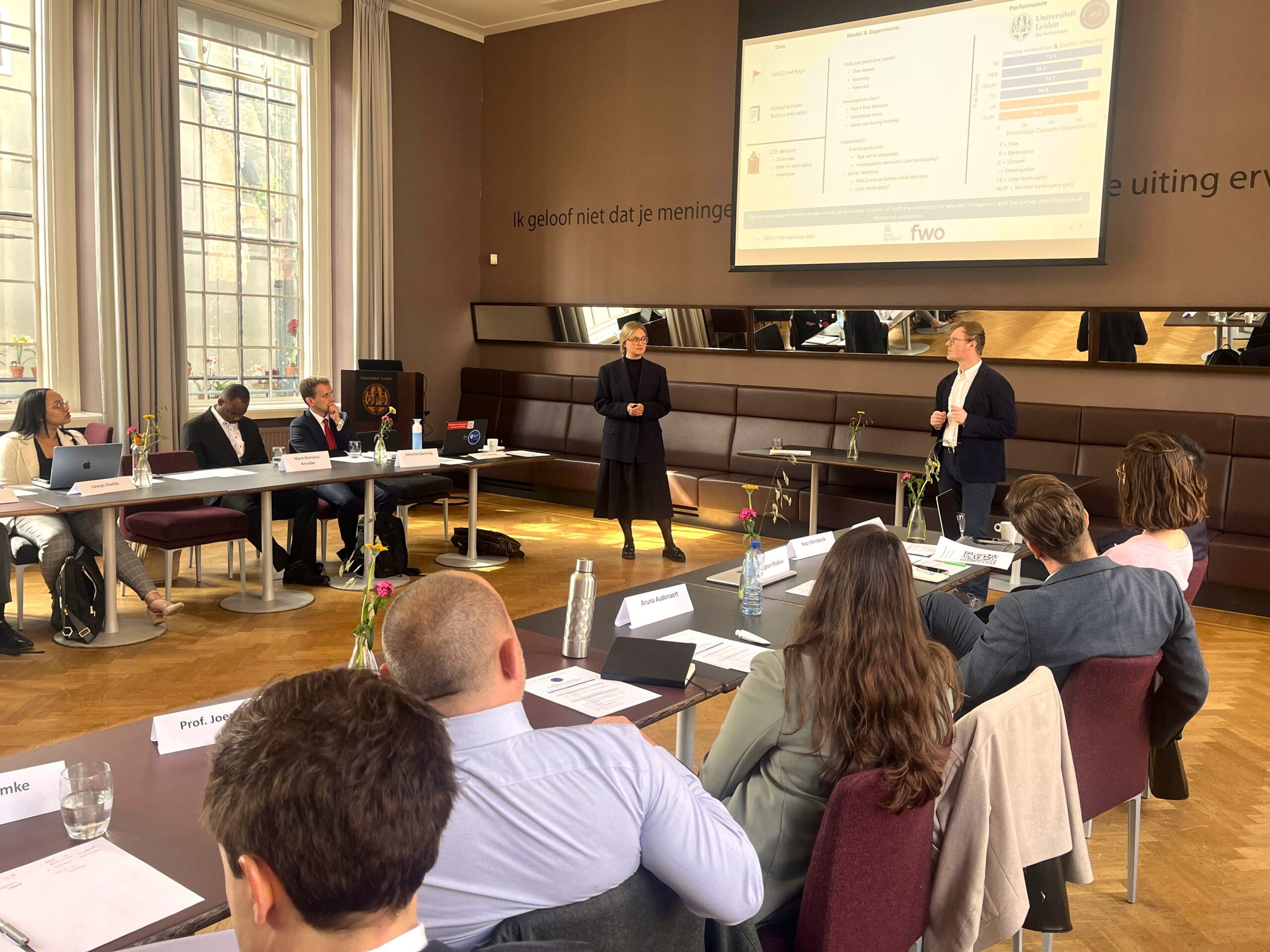
This research was presented and discussed at the last PhD Workshop on European and International Insolvency law, organised by the Stichting Bob Wessels Insolvency Law Collection (BWILC). Since 2018, BWILC maintains the private insolvency law book collections of Prof. em. Bob Wessels, extended with the collections of the late Prof. Ian Fletcher and the late Gabriel Moss QC, in addition to books that have been kindly donated by scholars and practitioners from around the world. To browse or visit this unique collection, click here.
Since 2019, BWILC organises an annual PhD Workshop for PhD students from Europe and beyond. At this workshop, PhD candidates can present their ideas, but also the challenges and questions they are confronted with in a two-day workshop attended by their peers and senior academics. At the end of the workshop, organised alternately in Leiden and another city, prizes are awarded for the best presentations.